How committed are you to your goals?

“It is our choices that show what we truly are, far more than our abilities.”
— J. K. Rowling in Harry Potter and the Chamber of Secrets

Today was our wedding anniversary. And, as with every date that celebrates a moment in time, or marks an occasion, it is a time for contemplation. At least for me.

I wondered at the fact that we reached this date against all odds. Obviously on the decision scale, staying together weighed more than splitting up. As with all change, there is a lot of stress involved when two people decide to live together. Two often very diverse lives are merged, sometimes with different values and definitely with different viewpoints and ways of doing things. Yet, because of love, we make it work. And it seems to be working fine, so far. We are both committed to making this marriage work, and that counts for a lot.

Marriage or even relationships in general, is not the only aspect of our lives that requires a level of commitment. Our choice of employment, our choice of residence, our health, our studies – the list is endless. The chance of success in all these areas seems unattainable – unless we are committed. And right there – there is the keyword: commitment.

The word commit comes from the Latin word committere, which means to connect, entrust. When we stand behind our words, we demonstrate commitment. Commitment exists when our actions meet the expectation of our words – when there’s a congruency between intent, words and action.

This commitment to one’s goals is most definitely the most important rule for success. Without it, we fall prey to procrastination, bad habits, laziness, rationalisation and a host of goal-defeating problems. Commitment is a strong word – much stronger than “agreement.” If I agree to meet you for dinner, I have three options: keeping my agreement, cancelling, or changing it. If I commit myself to meeting you, I will meet you no matter what.

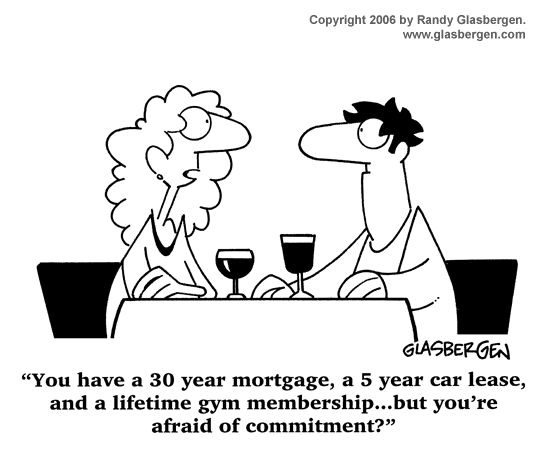
Why is commitment to our goals so difficult? We have even labelled this difficulty: commitment-phobia. It is an easy term to bandy about, especially when it comes to relationships. Fear of commitment in much popular literature refers to avoidance of long-term partnership and/or marriage but the problem is often much more pervasive, affecting school, work, and home life as well.
Commitment

Commitment fear/phobia is not only about balking at the idea of being in a steady, exclusive relationship. It is about not buying that house because of “what if”, or not embarking on a career or even a study direction. It is about not making good health choices, or not sticking to them.

When you are committed to your goals, attaining them is easier. Your choices are clearer. If your goal is to be the top salesperson in the company where you work, your actions will be congruent with this goal. You will make more calls, more appointments, and close more deals. You will put in more hours, because achieving this goal will mean more success and yes, more income, for you. Making those extra calls won’t be easy, but if your goal is clear, you will do it. If your goal is to shed extra weight, the choice between grated carrot and a chocolate cake won’t be so difficult. It is when you are not committed to your goals that choices appear to be hazy.

We are still here to celebrate our wedding anniversary not because we are still in love. There is that, but often love is not enough to wield against the petty conflicts. It is commitment that keeps us together through the darker times, and that reminds us that things have been better, and will get better.

Talk to us at Chrysalis Coaching about achieving your goals. About being committed to what you want. For an appointment, call Jolindy on 082 780 9209. For more info, please “like” our facebook page here: https://www.facebook.com/chrysalisnlp

Mornings happen to other people… Do they?

I used to be a very reluctant morning person. Come time for the sun to peek over the horizon, all bright-eyed and bushy-tailed and raring to go, my brain would do what it was supposed to do the previous night – shut down and go into sleep mode.

I would try various tactics – self-talking by telling myself everything I had to do, and that I had to get up to set a good example to the staff (in Botswana I used to work for a media moghul called Mr Jones who was at the office at the crack of dawn, and left late at night after the last staff had gone home, and he was 70!) I would threaten myself, promise rewards to myself, motivate myself with various wake-up audios – all to no avail.

Then I discovered NLP, and most importantly, limiting beliefs. Here is one really good definition about what beliefs are: Beliefs are convictions or acceptances that certain things are true or real. They are generalisations about the world. They are our on/off switches about whether we can do anything. They are conscious enough to be valuable. NLP says that the beliefs that we hold give us both strength and empowerment. So, it becomes important to have the belief that can enhance your ability rather than restricting it.

I took my limiting belief (I am not a morning person) to an NLP session while I was still studying some of the techniques, and I was amazed at how quickly this belief changed. In a single session, using NLP techniques, the root cause of my limiting belief was determined, and it was replaced by a new empowering belief.
I am now not only a morning person, but I am an all day person. I can function at optimal level when required, and I can rest when I feel like it, and when it is necessary.
 
As an NLP Master Practitioner, I can help you make the same changes to your world. What limiting beliefs are holding you back from realising your full potential? Let’s challenge these beliefs, and let’s replace them with beliefs that serve you.

Emotions… Are you the puppet? Or the puppet-master?

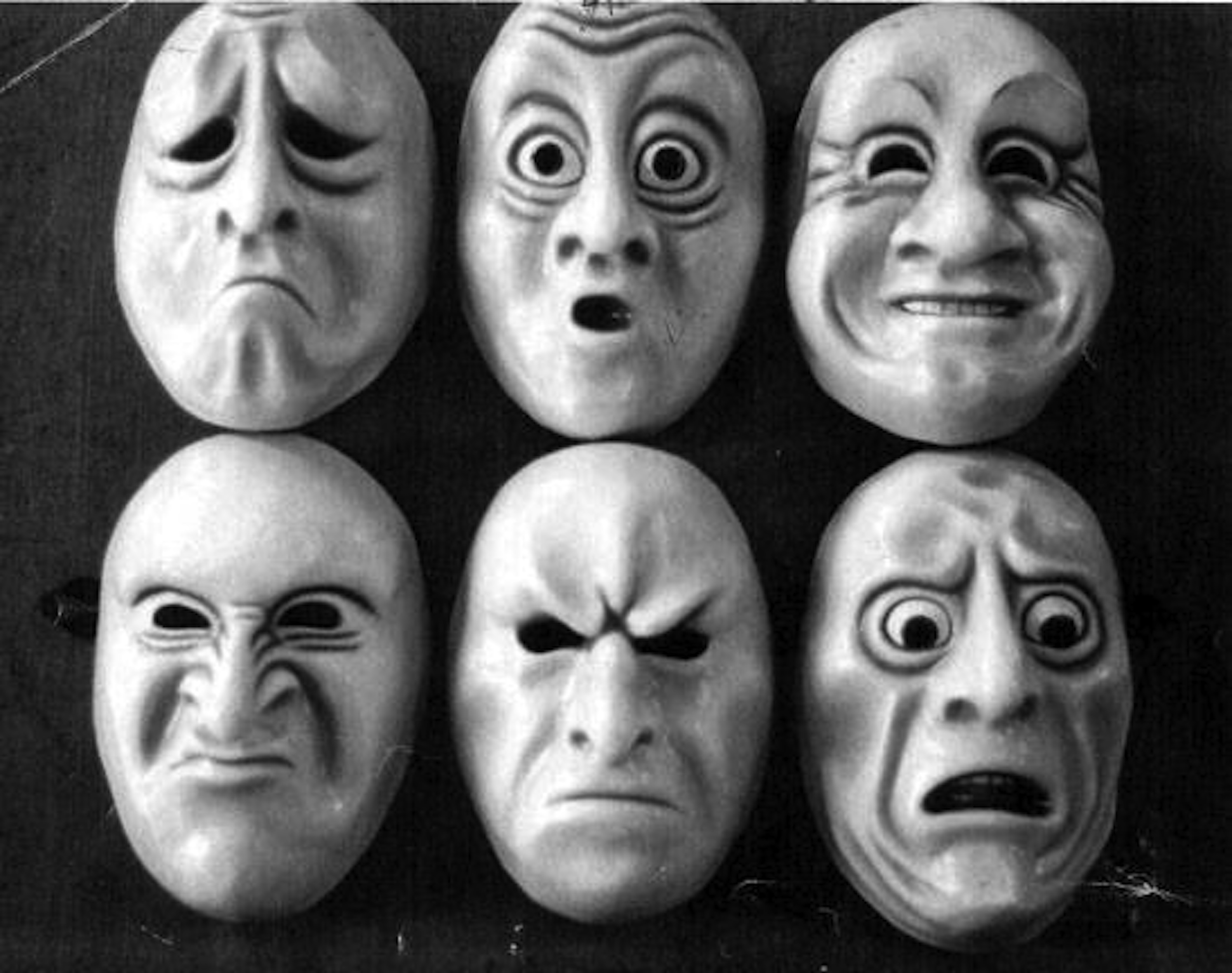
Our emotions allow us to have a giddy rollercoaster ride of sensations – from happiness to sadness, from elation to anger. Often referred to as the barometer of the soul, emotions are the filters through which we experience our world.

Image

Different people define emotions in different ways. Some make a distinction between emotions and feelings saying that a feeling is the response part of the emotion and that an emotion includes the situation or experience, the interpretation, the perception, and the response or feeling related to the experience of a particular situation.

“Emotions are human beings’ warning systems as to what is really going on around them.  Emotions are our most reliable indicators of how things are going on in our lives.  Emotions help keep us on the right track by making sure that we are led by more than the mental/ intellectual faculties of thought, perception, reason, memory.” – Dr. Maurice Elias

“Emotions operate on many levels.  They have a physical aspect as well as a psychological aspect.  Emotions bridge thought, feeling, and action – they operate in every part of a person, they affect many aspects of a person, and the person affects many aspects of the emotions.” – John D. (Jack) Mayer

When we allow our emotions to control our actions, then we become puppets. We can “surf the wave”, ride out emotions (especially negative emotions such as anger, sadness, fear, hurt, guilt, shame) and take control of our reaction to these. So often we find that people place blame for actions outside of themselves: “She ‘made’ me angry, so I lost control.” Lost control of what? How specifically did she “make” you angry?

We can take control of our emotions. We can experience the emotions fully, and if we don’t like the result we see, especially with negative emotions, we can help you find the root case with Timeline Therapy, and release your negative emotions.

Emotions can control your thinking, behaviour and actions.  Emotions that are not felt and released but buried within can cause serious illness, including cancer, arthritis, and many types of chronic illnesses.  Negative emotions such as anger, sadness, fear, hurt, guilt, shame and depression cause chemical reactions in your body that are very different from the chemicals released when you feel positive emotions such as happy, content, loved, accepted.

Your emotions should serve you – you should not be a servant of your emotions. Become the puppet-master in your world. Make a commitment today to yourself to become emotionally healthy. It takes a lot of wisdom to realise that nobody can make you do anything, nobody can change you. And neither can you make anybody else do anything, or even change them. Avoid those situations that you know will create conflict and upsets.  You cannot change others, you can only change yourself.

Do something extraordinary TODAY

Each one of us has a bucket list, a wish list, a to-do list. We have lists of dreams of what we want to do, what we want to accomplish, where we want to go, what we want to see, to hear, to experience. The sad thing is that these lists are all filed away somewhere, to be accessed every now and again, looked at, and put away until ONE DAY where we’ll have time for such things.

Image

When is your one day? When will you ever have enough time? When will you have enough money? What is enough? And my final questions that I’d like you to ask yourself is: until then, until you’ve decided this is the day, how happy are you? What are you doing to pass the time until you allow yourself freedom from the race against time? Because, well, while you are waiting for enough money, or enough time, the clock is not standing still. You are getting older… Life is passing you by.

Image

My challenge to you today, dear co-inhabitant of planet Earth, is this:
Please take out your want-to-do list. Dust it off, and give it a place of honour where you see it every day. Take something on the list, and do it now. Do it today. You only have one life, you only have this chance to do what you want to do. One day, whenever it is, may be to late. Today is your day to do something EXTRAORDINARY. Do it.

NLP and Advertising

It really hit home when I noticed my last blog post on this site was in November, LAST YEAR. What happened that kept me away so long from one of my favourite passtimes, writing?

Well, I can tell you. Since November last year up to now I have been up to my eyeballs in books. I have been studying and immersing myself in NLP, aiming for my dream – my Master NLP Certificate and my Master Timeline Therapy Certificate. As with all things, it wasn’t just enough to know the skill sets, but I wanted to make them a part of me.

So towards the end of May, off we went to Egypt, where I had intense class and practical NLP with Sarah Merron from Fire Dragon Coaching – one of the greatest trainers I have come across. (And believe me, I have done numerous courses).


Since obtaining my Master NLP Practitioner Certificate, some people have asked me how I am going to be using this in our advertising agency. Well, this article by Steve Andreas explains some of the benefits of a knowledge of NLP with regards to copywriting, and I hope that you find time to read it.

But I will not be only using NLP in our agency. As a lifecoach, the NLP skill set is invaluable in assisting clients with various solutions. As a business coach, with NLP we can help transform your company. Contact me, and see how NLP can be of benefit to you.

Image

–by Steve Andreas

NLP in Advertising–Salvation Army Poster

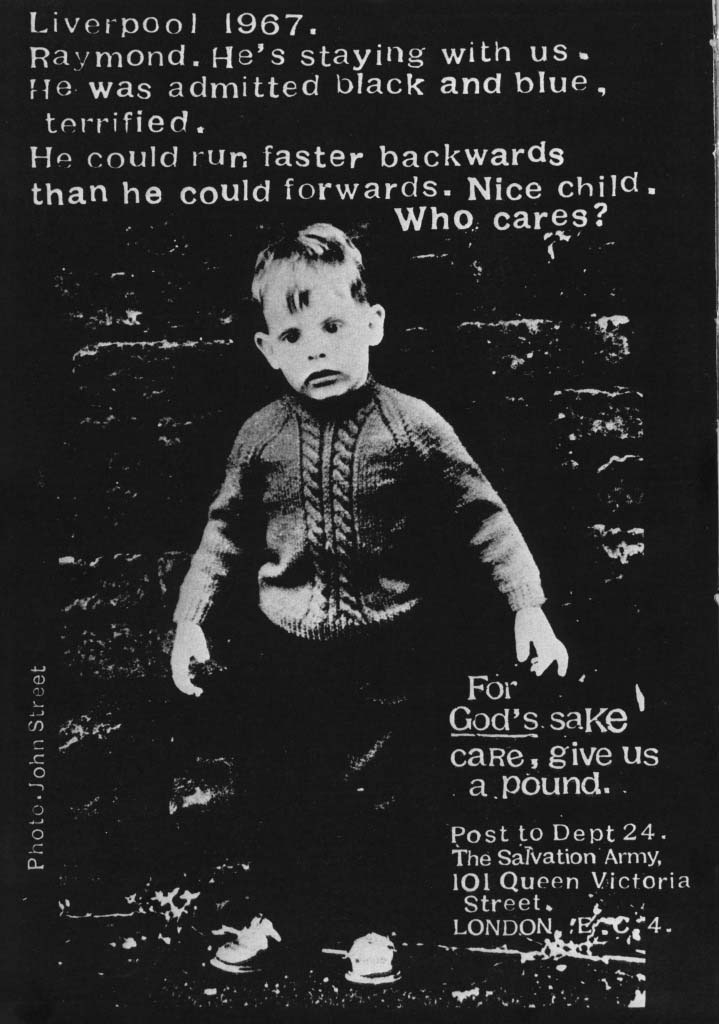
The poster shown above was used by the Salvation Army in the UK. The first version of the poster was exactly the same as shown above, except that the word “CARE” after the words, “For God’s sake” was omitted. This first version was very successful in raising a lot of money. Then they added the word “CARE” as shown above, and donations dropped precipitously. How did the addition of this one word ruin a great ad?

The image of the small child who looks very confused and in need of help is probably what first meets the eye for most people, eliciting a theme of need and a response of caring.

But the words are important, too, including the words on the top of the poster eliciting sympathy for the child. The statement that the child could run faster backward than forward is particularly unique and evocative. Elegant.

The typography is also relevant. Using letters of different fonts, irregularly placed, looks like whoever made the poster was also quite needy. (Imagine the same poster, but with slick, nicely aligned typography, and notice the difference in your response.) And the blotchy look of the photo and the poster as a whole echoes this.

“Nice child” adds an amplification; not only has the child suffered, but it is a nice child, who surely doesn’t deserve such treatment.

“Who cares?” is an rhetorical question that is covertly directed at the reader, and which most people will respond to—either consciously or un—with feeling caring or empathy, and an inner “I do”—a very graceful amplification of what the reader is already feeling in response to the previous image and words. Everything at the top and middle of the poster is congruent in expressing need and eliciting caring.

“For God’s sake, give us a quid,” is a simple command, and again the whole focus is on the needy child, congruent with the words at the top of the page, and the neediness implied by the haphazard typography, etc. So the whole message is very direct and congruent, focused solely on the child’s need. Very elegant.

However, when the last sentence was changed to “For God’s sake, CARE, give us a quid,” that one word changes the focus, diverting attention from the congruent message that has been so artfully established. Now it is two separate commands, directing the reader’s attention in two different ways:

“For God’s sake, CARE,” commands the reader to CARE, directing attention to the reader’s feelings, a shift AWAY from attention to the child’s need.

Then “Give us a quid,” directs attention to the child’s need again; but it is too late; the carefully woven spell has been broken. How? Not only by the interruption of “For God’s sake, CARE,” but because this command has an uncomplimentary implication—that the reader doesn’t already care.

If the poster assumed that the reader was already caring, there would be no need to command the reader to care. If we assume that the reader is a caring person who has been responding congruently to the poster’s multiple eloquent pleas, the command to CARE (CARE emphasized by CAPITAL letters, which is a bit crude or rude in itself) is something of an insult, and not likely to induce them to give. And it didn’t.