Let’s talk digital by Creative Touch: Can the real digital marketers please stand up?

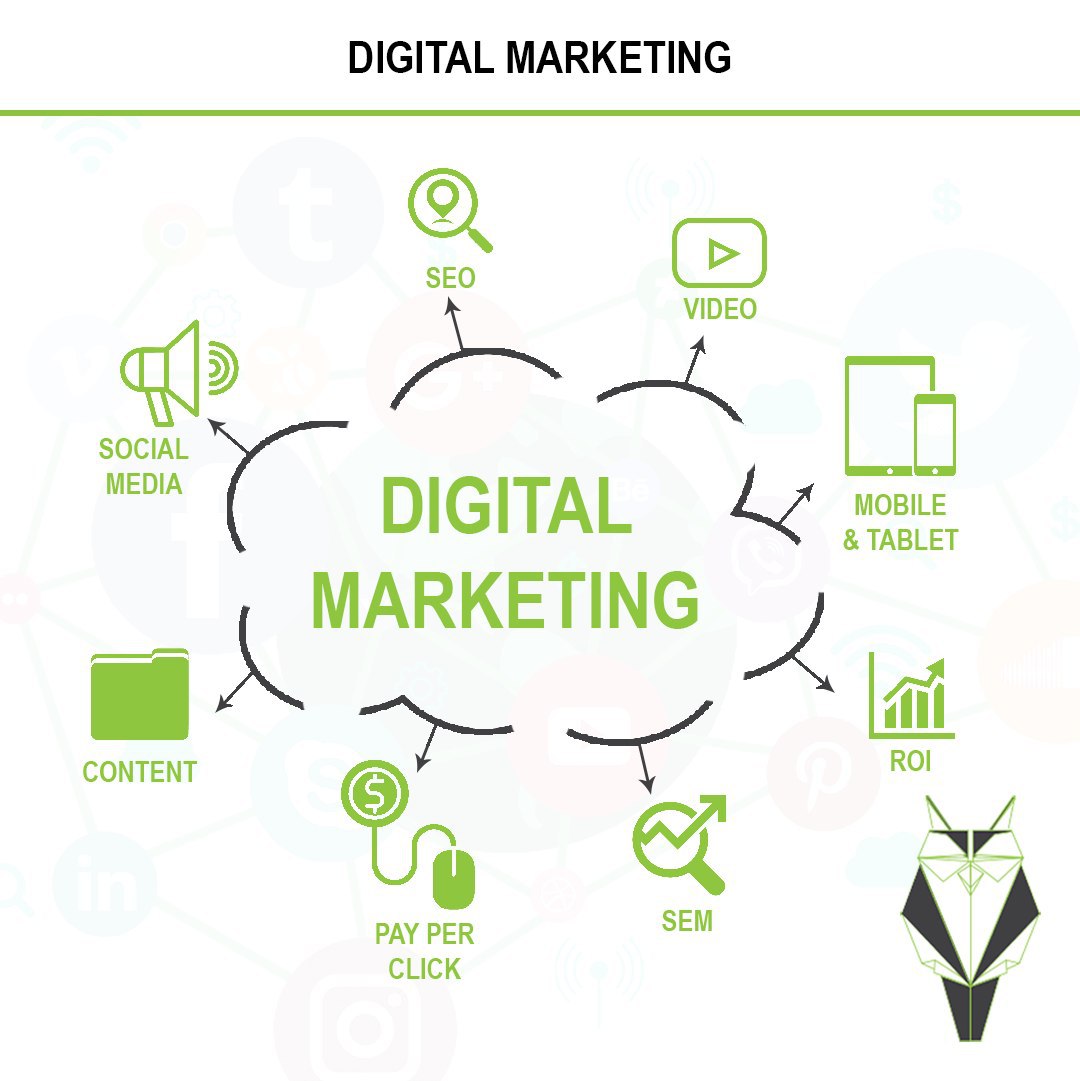
Digital marketing

Let’s be frank – nobody wakes up in the morning and enthusiastically jumps out of bed, saying: I cannot wait to spend money on marketing and advertising my business today! In a perfect world, that would be great, because marketing is one of the cornerstones of a successful business. But is has become a grudge expense, something we resent paying and the first thing we want to scratch when the belt has to be pulled tighter.

Why? I’ve always asked myself. I am a passionate marketer, I’ve been in marketing all my life and I simply cannot see myself doing anything else. There is nothing like sitting down with a client, brainstorming ideas, seeing those ideas implemented, being a part of the action and seeing a positive difference of which I am privileged to be a part.

However, over the years I’ve seen a trend, starting when I owned my very first fledgling advertising agency and publishing company in Gaborone, Botswana. My father-in-law thought he could also do what us young, and to him, inexperienced folks, were doing. Our work didn’t look that hard (he didn’t see the long hours), and he decided to open a marketing franchise in a new town that they just moved to. It didn’t work, and he ended up closing it a couple of months later. When we discussed it later, he ruefully admitted that this was not for him.

Years later, in 2001, I opened a marketing and publishing agency in the Garden Route. I’ve had staff members over the years who worked for me, and after a couple of months decided they know it all, opened opposition to us, undercut our pricing and are selling a solution they really know nothing about. You cannot learn decades of knowledge and experience by watching what somebody does for a couple of months, and then also not stay updated by continuing to study. All. The. Time.

We find ourselves in an environment where people are unwilling to invest in real expertise and knowledge. Most businesses want a quick solution, and they want it cheaply. A plaster is not going to fix existing problems overnight. And charlatans and pretenders are unable to keep up the ruse, to discerning business owners who understand what ROI means and how to measure actual results. Unfortunately, there are many, many small businesses who DO NOT understand how the digital space really works and they are taken in.

Then there are the actual businesses owners who were taken in, and who are now disillusioned. They do not believe in marketing at all, least of all this newfangled thing they do not really understand, called digital marketing. They threw good money after bad, and are reluctant to repeat the experience.

There are many credible agencies out there, including ourselves, who take our clients’ investment in their marketing very seriously. There are a couple of red lights that one could keep an eye out for. Is the agency wanting to run with your marketing a legitimate business? Do they have offices, staff, the right background, equipment? Who are their other clients, and how long have those clients been with them? Are they trying to strong-arm you into a contract, or are they willing to work on a month-to-month basis, measuring regular feedback and results?

Speak to us for a free digital audit, where we can give you advise on what you currently have, where you are positioned digitally and how it can be improved. Or attend one of our social media seminars – I am passionate about teaching, and believe in sharing knowledge as knowledge is empowering. Visit our website: http://www.creativetouch.agency or email me direct: jolindy@besociable.co.za
Let’s talk digital by Creative Touch: Are Social Media Accounts the Property of my Business?

I thought long and hard about what the title of this article should be, and it is what it is. As a digital marketing company, we often come across clients who need assistance in marketing a business they just bought. They are all excited about having a social media presence, and getting us, Creative Touch South Africa, on board to sort it all out. More often than not, though, especially when buying over an existing business, there is already a social media presence. Now suddenly there is a dispute as to ownership of these platforms.

Look, it is really quite simple. When you buy a business, you buy it as a complete, operational entity. If you’ve been involved in the selling or buying of a business, you’ll know that when a business is sold there are different business assets that may be transferred as a part of the transaction to the purchaser during the sale.

Traditionally, transferred assets include the existing stock (if any), the equipment, vehicles (sometimes), furniture, supplier information and sometimes, client databases. Nowadays though, most businesses also have web pages and social media accounts that link directly to the business. These web pages and accounts contain information pertaining to the business, including addresses and contact numbers. There will be, on social media specifically, a creation date of the account, which also adds credibility as to how long the business has been online. There will also be existing analytics data, page fans, followers, etc. These are all assets from a marketing point of view. So now many business owners want to know whether these items count as the property of their business. The answer is yes, it is the property of the business. Which means when the business is sold, it stays the property of the business, like all the other assets, and should be transferred to the new owner.

There is sometimes a misunderstanding as to how to transfer ownership of social media accounts. In reality, it is very simple. It depends on what platform it is. Some accounts, such as Instagram, require a user name and password. Some accounts, such as Facebook, require an admin to be added to the page. Facebook can be tricky, because not everybody understands exactly how it works, and the platform used to also allow a business page to be run independently with its own user name and password. This has not been the case though for years, and Facebook business pages can only be accessed if a user is connected to the page via one of the admin roles.

Unfortunately, many people are under the perception because the business page is linked to their own personal profile, handing over the page will impact this. This is not the case at all. On Facebook specifically, you can have multiple “Admins” on a business page. There are other page roles available, such as “editor”, “analyst” and more – all of these roles have a place and a specific function. An owner though, should be “admin” as that gives full control over the page. There is a 7 day period during which a new admin cannot alter the role of any of the other “admins” or even remove them, you can only add. But as soon as the new admin is active, other admins can just remove themselves from the page. Be careful though, Facebook allows an admin to leave a page completely, which is then a headache of note to try and recover from “outside”. Also, if an admin leaves and the only roles left on the page are editors, there can be no new admins added, and an editor role cannot promote itself to the admin role. So be sure to transfer correctly, as the default role under the Page Roles section under Settings is “editor”.

Ideally, in a perfect world, a seller would make provision for the transfer of all the accounts, and keep the necessary user names and passwords secure to be handed over upon completion of the sale. If the seller chooses not to do this, and keep the accounts, there will now be duplicate accounts online, which will make marketing very difficult from a search engine point of view. How does the public know which account/page/channel to visit? If the seller chooses to deactivate all the accounts, this is again problematic, as it would mean that all of the followers and fans would be lost and the buyer would need to start from scratch. This would defeat the purpose of the buyer gaining access to the social media accounts if there is value and goodwill in the original accounts through existing social media pages and followers and subscribers.

The content of this article is intended to provide a general guide to the subject matter. Specialist advice should be sought about your specific circumstances with regards to social media accounts. Speak to the team at Creative Touch South Africa if you require any advice on this or other digital matters: info@creativetouch.agency


Facebook updates look to News Feed

On Monday, Facebook announced an updated look to News Feed: an updated design for desktop with bigger images and photos are rolled out, with the vast majority of people only seeing minor changes, and the current design on mobile remaining the same.

In addition, Facebook has also simplified how photos render on desktop News Feed when you upload multiple photos at once – either as a photo album or multi-photo story.

These updates do not change creative asset requirements for any of the ads as all ad specs and image aspect ratios will remain the same.

The new design for facebook pages:

Image

There has been a mixed reaction from users to this announcement, from excitement at the rollout, and congratulatory messages to Facebook, to disappointment from business page users questioning the new features, saying the new layout looks “too busy”, with the biggest complaint seemingly being that the custom tabs are now no longer visible at the top of the page.

More details can be found in these one-sheet PDFs (in English):
Updated look of News Feed overview: http://bit.ly/1g43ZUI
Multi-photo upload: http://bit.ly/1qoCdXR

Facebook starred reviews for business pages

We’ve had some questions lately at Be Sociable about the starred review section on facebook business pages. 

Image


First of all – it is an excellent feature. The starred review section allows people to give your business a rating of 1 – 5 based on their experience, as well as an option to add a written comment.

Obviously it is also important to make sure that your page type is correct. The starred review feature only works on physical entities, which means pages that are set up as “local businesses” or “companies and organisations”.

Why is this excellent? Think TripAdvisor. Your ratings give people who is not yet familiar with your product/service the opportunity to – at a glance – get an idea of what other people think of your business. Obviously if you have a good business with good customer relations, your ratings will be positive. If not, your ratings will plummet.

At the moment the starred review section only seems available to businesses with a physical address – to those businesses who only have a website, the option doesn’t yet seem available.

The process seems fairly easy, according to directions found in the Facebook Desk Help section :

  • Just visit the Facebook page of the business you want to review.
  • Scroll down to the review section on the right hand side of the timeline.
  • Fill in the number of stars (total of five) that reflect your experience with the business.
  • Fill in a written review as well in the space that asks “What do you think about this place?”
  • You can mark your review public or select the friends, acquaintances or other connections you want to be able to see it.
  • Then hit “Review” and you’re done.

Page owners be careful. You automatically enable the Facebook starred review feature by adding your physical address on Facebook. Facebook warns you cannot remove individual reviews. So the only option is to remove the review function completely by taking your address off your page.

How Facebook Starred Reviews are Different

Of course it’s impossible to think about the new Facebook review feature without considering all the controversy now surrounding online reviews.

According to Joshua Sophy, in September, small businesses in New York state faced $350,000 in fines after the attorney general’s office said they had hired freelancers to write fake online reviews.

Facebook allows only those with an account to write a review. But how many fake Facebook accounts are out there is anyone’s guess. At best, the new Facebook starred reviews feature should probably be viewed as another way to collect feedback and generate social interest rather than an objective measure of customer sentiment.

Why Social Media Marketing Should Be Taken Seriously For Your Business

We are an advertising agency, with our roots firmly established in the Garden Route. Our motto has always been to deliver the best service to our clients, and offer the best advise with regards to budget-spend that leads to maximum return on investment (ROI). We even used to own our own publications – some of you may remember some of the titles: Vibrant Living, Business Bulletin and Garden Route Property Finder amongst others. Some of these publications we sold, and the last one, Business Bulletin, we closed down ourselves after a successful 12 years. Why you may ask?


Image

Well, let’s start at the beginning. Advertising and marketing is my passion. It has always been, and it will always be. There is nothing as satisfying as a client who becomes a friend and who trusts us to build their brand, while they focus on the nuts and bolts of growing the business. Our core services has always been brand assistance, be it graphic design, copywriting, print solutions – whatever the client required. We would design advertisements for local newspapers (including our own) for clients and  assist with annual strategy planning around marketing budgets.

We started realising that people don’t really read as much physically printed matter as they used to. The forward-thinking publications are all moving online, and you often see people, wherever they are, cluthing a smartphone or an iPad or tablet, browsing the internet. Our target audience has moved online – and that is where we firmly believe our clients should be marketing themselves.

We’ve simply moved our advertising agency online, and opened a strong social media leg: Be Sociable. Social media is an excellent marketing platform choice – with the constant change-over to technology, and with iPads, Tablets and smart phones becoming more accessible and more affordable, more and more people are online. It simply makes sense to advertise your product where your target audience already spends a lot of time. Less people pick up newspapers, magazines, booklets, etc, and prefer to spend time online. Also, as with all responsible businesses, we realise that our eco-footprint makes a substantial difference in the world we inhabit, therefore advertising in printed media really makes little sense. Also, if you compare print media costs to online media, there is simply no comparison. You get far more results online for less expenditure.

Here, I cannot put it better than Marsha Friedman, and I agree with every word.

What tends to be happening now, though, is that businesses are realising that they should be on social media, but they are using the wrong approach.  I remember when the internet first gained prominence and it became apparent that having a website was essential for any commercial enterprise.  Back then, web designers were not plentiful and few people thought to hire a professional to create a site. They felt that any web presence was better than none at all and they found people they knew who were “into the whole internet thing” to help them.

As an advertising professional, when I saw a website that didn’t represent people well or looked amateurish, I’d ask who created it. Invariably, I’d get answers like, “My nephew did it,” or “I bought Web Design for Dummies and did it myself,” or “My son has a friend who just graduated with a degree in computer science.” While those days have passed for websites, I’m afraid I am seeing the same thing happen with regard to social media.

As social media has become an integral element of all mainstream media, some people regard it the same way they used to regard websites—as a good addition to their marketing tactics, but not so essential that they need to approach it with a professional sensibility. As with any marketing outreach, social media done badly will actually set a person back rather than move him forward.

At the end of the day, social media is serious business. Done right, it can create a base of thousands of followers. Done wrong, it wastes time and energy and, most important, gives people the impression that social media marketing isn’t important. In fact, it has become one of the most critical and fundamental components for any marketing strategy, which every company needs to put in place.

Speak to the Be Sociable team and book a free session with one of us – we will happily evaluate your current social media presence and advise you on the best way forward.

10 reasons to hire a social strategist and community manager:
I’ve said it before and I’ll say it again: if you’re not on social media, then you’re not where your audience is—and you’re missing out. The social media potential for brands is astonishing, and it includes:
•    An endless stream of information and trends that are happening in your industry
•    The chance to check out your competitors to evaluate what you are doing right (and potentially wrong)
•    The ability to engage one-on-one with your audience and form a more personal connection
•    Tracking mentions of your brand online so you can offer customer service through social media and answer inquires (as well as dispel myths)
•    Content creation and curation
•    Community-building
•    Increasing advocates of your brand through word of mouth marketing
•    The opportunity to increase trust and  credibility with your community
•    Social media can be used for sales


An Introduction to Social Media Marketing and Internet Marketing

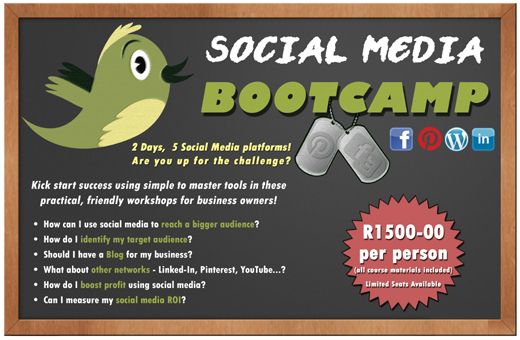
This isn’t a standard blog post, but a course outline of our upcoming social media bootcamp that we are launching in October 2012. Please feel free to contact us at the numbers or emails below for more details with regards to venues and dates near you.

Course Pre-requisites
–  Computer and Internet Literacy
–  Familiar with social media platforms like Facebook and Twitter
–  Laptop with Internet Connection for duration of Course
Course Materials Included
–  Digital course materials (Infographs and Social Media Marketing ebook)
–  Templates: Facebook Profile Image and Cover Image


Course: Day 1

–  What is Social Media and Internet Marketing and how would it benefit business?
–  Inbound Marketing vs. Outbound Marketing and under what category does Social Media and Internet Marketing fall?
–  Sociomapping and Sociograms: Identifying your target market (group) and analysing the preferences within the group.
–  Reaching your target market with Facebook: What does Facebook offer and why should I use it.
–  How-To (Practical): Setup a Facebook Page
–  How-To (Practical): Setup a Facebook Group

Assignment A: Identify your company or organisation’s target market / group and build a sociogram to represent Social relations,
channels of influence or lines of communication within your target market.

Assignment B: Create a Facebook Page and/or Group for your company or organisation and attempt to reach the target market identified in Assignment A
Course Day 2
–  Reaching your target market with Twitter: What does Twitter offer and why should I use it.
–  Reaching your target market with Linked-in: What does Linked-in offer and why should I use it.
–  Reaching your target market with Pinterest: What does Pinterest offer and why should I use it.
–  Reaching your target market with a blog: Why should I have a blog and a website, what are my options.
–  Optimising your blog content: Making sure your message maximises your marketing opportunity .
–  Reaching your target market through other social media platforms: What other options are there and when should I use it.
–  Why should I and How do I link it all together to maximise my inbound marketing potential.
–  Conclusion of Course.

Assignment C: Create a Linked-in profile for yourself and your for your company or organisation and attempt to reach the target market identified in Assignment A

Assignment D: Create a Pinterest profile for yourself and a board for your company or organisation and attempt to reach the target market identified in Assignment A

Assignment E: Create a blog your for your company or organisation and attempt to reach the target market identified in Assignment A

Assignment F: Time to link it all together.
Total Course Time: +/- 8 hours

For more information on this and other courses feel free to contact us today!

Jolindy Dreyer
B.A. Communications (UOFS) • NLP Prac. (FDA UK)
Cell: 082 780 9209
E-Mail: jolindy@dreycor.com
Facebook: www.facebook.com/roisocialmedia

Linked-In: www.linkedin.com/in/jolindy

Twitter: www.twitter.com/jolindydreyer
Zac Dreyer
B.Tech. Information Technology (UNISA)
Cell: 082 378 7386
E-Mail: zac@dreycor.com
Facebook: www.facebook.com/roisocialmedia

Linked-In: www.linkedin.com/in/zacdreyer

Twitter: www.twitter.com/zacdreyer

Why is social media one of the most important marketing tools?

If you are in business, then you are marketing your business. All business owners are (or should be) searching for the best or most important ways to market themselves, their products or their services. And of course, cost is always a factor. We understand that we have to spend money to make money, but we want to save money in the process.

I’ve been involved in social media marketing since before the concept was officially known as social media marketing. And this article is just my opinion on the matter – I would love to hear what you think.

Now, let’s get to the point. Why is social media one of the most important marketing tools?

Social media gives you a more direct path of contact between you and your market. Having a strong social network allows you to communicate effectively with existing and potential users. More “traditional” marketing tools allows for pretty much one-way communication, but with social media you can directly interact with your client base. One of the most important aspects of using social media as a marketing platform is the fact that you are able to access a massive market that would otherwise be inaccessible through traditional media (unless equally insane amounts of money are spent). Social media makes connecting with customers easy.

Now, even today, I am exasperated to hear clients say: “But I don’t use facebook (or twitter or google+ or….). I cannot see how it can be of value to my business to have a social media presence.” And my answer is: If you aren’t using social media yet, you’re missing out on a vast, untapped group of potential customers. These days, almost everyone is plugged in and connected online – Facebook has more than 900 million active users and Twitter has almost 300 million. Is this really a user base that you can afford to disregard?

What can social media do for your company?

Firstly, by actively using social media outlets such as Facebook, Twitter, Linkedin, Youtube, Pinterest, etc you can raise awareness of your company to a very large community. Just like placing a newspaper, radio or television advertisement, social media is an easy way to get your company name in front of peoples eyes.

Secondly, social networking connects your with a large chunk of active online users and can generate leads of all kinds for most businesses. You can tie awareness in with promotions and competitions, and run a very effective online campaign which can only benefit your business.

Once you’ve established your network, it doesn’t stay there. You constantly add new people, and you build relationships with your existing followers. Once you’ve established a connection or formed a relationship it is crucial that you maintain the correct impression. Relationships leads to sales.

Social media also allows you to improve your customers service. Because of direct communication, social media allows you to interact with potentially disgruntled customers and sort out any problems/issues that may exist. Social media also allows your happy customers to publicly share how satisfied they are doing business with you. This gives a whole new meaning to the concept “Word of Mouth”.

There are amazing tracking/monitoring tools available which allows you to access a valuable range of data about how people found you, who they are, how they came to view your website/social page, etc. With this info, you can work out the most effective ways to increase your social media network, adjust your campaign and capture your market.

In short, social media is a whole different way of looking at promoting your business. And if you look at how some of the larger brands embrace their ongoing social media campaigns, it can definately work for your business too.