“It is our choices that show what we truly are, far more than our abilities.”
— J. K. Rowling in Harry Potter and the Chamber of Secrets
Today was our wedding anniversary. And, as with every date that celebrates a moment in time, or marks an occasion, it is a time for contemplation. At least for me.
I wondered at the fact that we reached this date against all odds. Obviously on the decision scale, staying together weighed more than splitting up. As with all change, there is a lot of stress involved when two people decide to live together. Two often very diverse lives are merged, sometimes with different values and definitely with different viewpoints and ways of doing things. Yet, because of love, we make it work. And it seems to be working fine, so far. We are both committed to making this marriage work, and that counts for a lot.
Marriage or even relationships in general, is not the only aspect of our lives that requires a level of commitment. Our choice of employment, our choice of residence, our health, our studies – the list is endless. The chance of success in all these areas seems unattainable – unless we are committed. And right there – there is the keyword: commitment.
The word commit comes from the Latin word committere, which means to connect, entrust. When we stand behind our words, we demonstrate commitment. Commitment exists when our actions meet the expectation of our words – when there’s a congruency between intent, words and action.
This commitment to one’s goals is most definitely the most important rule for success. Without it, we fall prey to procrastination, bad habits, laziness, rationalisation and a host of goal-defeating problems. Commitment is a strong word – much stronger than “agreement.” If I agree to meet you for dinner, I have three options: keeping my agreement, cancelling, or changing it. If I commit myself to meeting you, I will meet you no matter what.
Why is commitment to our goals so difficult? We have even labelled this difficulty: commitment-phobia. It is an easy term to bandy about, especially when it comes to relationships. Fear of commitment in much popular literature refers to avoidance of long-term partnership and/or marriage but the problem is often much more pervasive, affecting school, work, and home life as well.
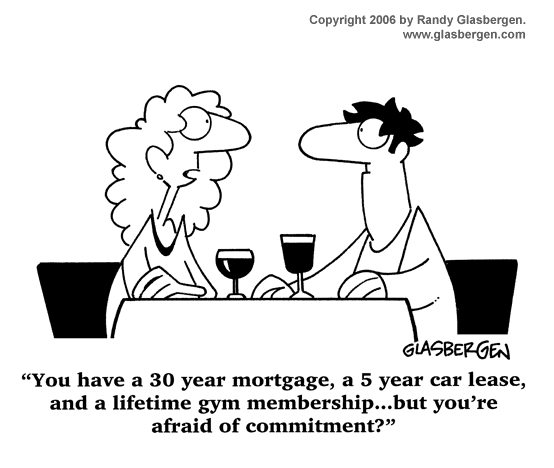
Commitment fear/phobia is not only about balking at the idea of being in a steady, exclusive relationship. It is about not buying that house because of “what if”, or not embarking on a career or even a study direction. It is about not making good health choices, or not sticking to them.
When you are committed to your goals, attaining them is easier. Your choices are clearer. If your goal is to be the top salesperson in the company where you work, your actions will be congruent with this goal. You will make more calls, more appointments, and close more deals. You will put in more hours, because achieving this goal will mean more success and yes, more income, for you. Making those extra calls won’t be easy, but if your goal is clear, you will do it. If your goal is to shed extra weight, the choice between grated carrot and a chocolate cake won’t be so difficult. It is when you are not committed to your goals that choices appear to be hazy.
We are still here to celebrate our wedding anniversary not because we are still in love. There is that, but often love is not enough to wield against the petty conflicts. It is commitment that keeps us together through the darker times, and that reminds us that things have been better, and will get better.
Talk to us at Chrysalis Coaching about achieving your goals. About being committed to what you want. For an appointment, call Jolindy on 082 780 9209. For more info, please “like” our facebook page here: https://www.facebook.com/chrysalisnlp
 faikonta