18 months ago I weighed over 160kg and my blood sugar was 27. Today I’m 40kg lighter.
Earlier today I posted a progress photo on Facebook after losing 40kg. Within minutes my inbox exploded with questions: How did you do it? What diet are you on? Is it even possible?
Instead of answering everyone individually, I thought it might be easier to share my story in a blog post.
Please keep in mind that this blog post reflects my own journey, decisions and research and in no way should replace consultations with your medical practitioner.
About a year and a half ago I got a wake-up call around my blood sugar. It tested at 27, and my doctor advised extreme and urgent measures. Against my wishes I started taking medication, but I’ve always believed medication doesn’t treat root causes – it tends to treat symptoms.
My weight was hovering just above 160kg. I was morbidly obese. My aim was simple: to lose at least 60kg in the healthiest and most sustainable way possible. I considered many solutions, and realised the first step would have to adjust my mind. Mindset is everything and determines results in everything we do.
I had a very bad fall a number of years ago which severely impacted my mobility. It impacted my quality of life and I fought an increasing depression and weight gain. The weight gain again worsened my mobility even further, so it became a vicious spiral. Also, I am fifty years old. My doctor told me that weight loss after forty is very difficult for women, and almost impossible to successfully achieve.
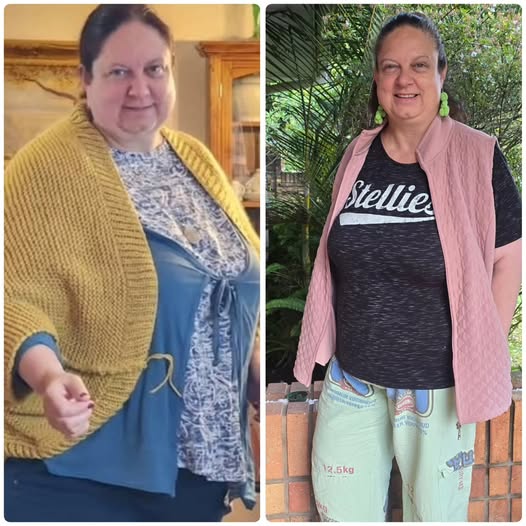
When I was diagnosed with Diabetes Type 2, my twins were just 8 years old. I found it inconceivable that my health would negatively impact their future. The thought of not being there for them not only terrified me, but catapulted me into action. I am a voracious reader, and knuckled down to research. Most research pointed to exercise for weight loss, but due to my injuries I could not do any exercises.
I discovered that exercise isn’t the only driver of weight loss. For me, nutrition and calorie control mattered far more—especially because my injuries limited my ability to exercise. In fact, the more you exercise, the hungrier you get and the more you want to eat. Which is great for already active people. However, for people who are significantly overweight, managing hunger cravings can be one of the biggest challenges when starting a lifestyle change.
If you are heavily and morbidly obese like myself, the first step is to calculate what would be a calorie deficit. Then get a calorie tracker and relentlessly record everything that goes into your mouth. Cut out all refined carbs, sugar, sodas, etc. Fat is not your enemy at all. Healthy fats are good for you and not only assist with weight loss, but keep you fuller for longer, curbing your appetite.
My calorie tracker is MyFitnessPal. It offers both free and paid solutions, and either works fine. There are a number of alternatives that can be downloaded and used. A calorie tracker makes it much easier to actually track your food and see where you can make alternative choices. It also helps you stay within your calorie count so that you can mindfully make choices around what to eat.
The biggest problem in eating less is that hunger cravings become a challenge. We are often told that fat is bad for us, so we shy away from fats and eat food that is in no way sustainable or manages to keep us fuller for longer. My research took me to explore more about the Carnivore eating plan, which is really fascinating with regards to how much better healthy proteins and fats are from a health perspective.
For myself, I found the pure Carnivore eating plan very restrictive and also expensive and difficult to maintain. Please understand that this was my personal preference, and in no way reflects any guidance for anyone else. What I found effective for me, and which is still a great and sustainable way for me to plan my meals, is to follow more of a Carnivore-Keto eating plan. I combine healthier vegetable choices with protein and good fats, which means I get to stay fuller for longer.
In addition to changing my meal planning around Carnivore-Keto and maintaining my calorie-deficit, I also fast for 17 hours a day. My first meal of the day is at 12, and my last meal at 5pm. Intermittent fasting helped me curb calories and encourage my body to use stored fat for energy. Starting out, one should consider a shorter cycle, and work your way up to longer hours.
All these changes sound difficult to do, and yes, I am not going to lie – they are. But it comes down to a choice: do you want to eat junk, or do you want to live? How much is that spoonful of sugar in your coffee or tea really worth in the long run? Is it worth your health and wellbeing?
Everything starts with your mindset. Making healthy choices is not just about knowledge, it is about having the willpower to persist. I am not yet at my goal weight, but I am over halfway there. This hasn’t been an easy journey at all. I am an emotional eater, and I struggle with depression and stress. My age and my injuries all counted against me, as well as most people saying it cannot be done.
This has been a time of getting to know myself better, of what triggers my bad habits, and of not obsessing over the numbers. My weight loss started off well, and then I had a really bad wobble which I struggled to get out of. I got myself into a pattern of dropping a bit, but climbing more, like one step forward and two steps back. It took a good talking to myself to get my head back in the game.
This journey hasn’t been perfect. There have been setbacks, plateaus, and moments where I felt like giving up. But I’ve learned something important: progress matters more than perfection. So far I’m 40kg down, and still a long way to go.
Please be kind to yourself. If you fall off the bus, it doesn’t mean the journey is over. It simply means you climb back on and keep going.
 faikonta