 I got a call late yesterday morning- the one when the phone rings, you recognise the number, and your heart plummets in your chest, because news has not been good lately, and you dread what you’ll hear when you answer. My mother passed away. Just like that. My closest blood relative, the person who brought me into this world, who gave me life.
Yes, I understand the irony of how I feel. I am an adoptive parent. I did not want children for many years, because I had such a tumultuous and abusive relationship with my mother. I was worried that I might turn out the be the same kind of mother, and I’d wish that on no child. And by the time I knew better, and I really yearned for children of my own, this is the route that worked out for me.
Somehow people think when you’ve lost an estranged parent, it is ok. You didn’t have much of a relationship with them, so why be sad? It is much much more complicated than that. I didn’t realise I’d feel this overwhelming grief. I manage to get my tears under control, only for it to all start up again at a thought, a smell, a word. My way of dealing with emotions is to do something, to cook, to write, to make something.
It is tough growing up without a mother. I had a person in my life, who gave birth to me, but who was in no way what a mother personifies. There was no love, no nurturing, no hugs, no care. Today, I wonder if she didn’t have postnatal depression, and was never diagnosed. But that doesn’t explain the constant abuse. I was eventually removed by social workers into state care when I was fifteen, and pretty much made my own way from there. That was 30 years ago.
It goes beyond explanation, but I constantly went back to try and remedy the situation. When I matriculated, I begged for a lift, and I made my way to where she lived. I wanted to share with her that not only did I matriculate top of my class, but I also got a very rare and much-needed bursary to go to university. When I knocked, and she saw it was me, her exchange with me was bitter. She told me in no uncertain terms that I am nothing to her.
It is tough entering the adult world without a mother. I’ve always had caring people who stood in the place she should have been, but it is not the same. I envied girls who had easy access to a mom to teach them everything they needed to know about transitioning into an adult. How to wear make-up, how to handle suitors, how to wear jewellery, appropriate clothes for specific events. Someone to giggle with about silly things, someone to whisper my dreams to who gave me complete support. Someone who stood up for me when I couldn’t on my own, who took my side when I needed an ally, who anchored me when seas got rough.
So yes, I yearned for a mother. I constantly tried to reconnect, and when I got married, I went to introduce my new husband to my real family, so he could be under no misunderstanding as to my origins. Poor, and from the complete wrong side of the tracks. We actually ended up staying with them for a few days – things seemed to be going smoother.
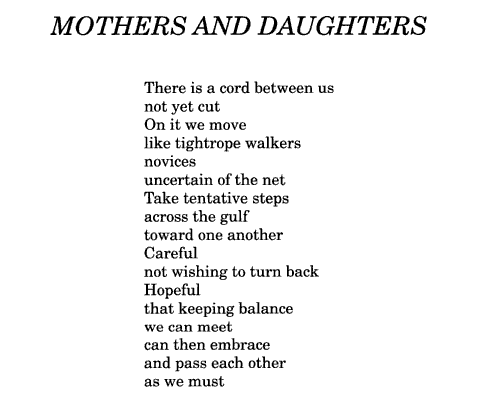
When my marriage fell apart, I went to fetch my mother to come and stay with me for a few days. I really just needed comfort and companionship. Comfort she had no idea how to give, companionship, she tried her best. It felt as if we were cautiously feeling our way towards each other.
Over the years, depending on my own income, I’d send money, or help buy whatever was needed: a fridge, a stove, groceries, essentials. It reached a point where it started feeling my mother would just contact me when she needed money or when she needed me to get something for her.
Our fragile relationship shattered to pieces again when I reopened our old wounds, and tried to explore why she abused me so badly as a child. She denied completely that anything of the sort had happened, shut herself off from all communication, and I left, angry. We went back and forth like this for years, with me just wanting answers and to understand, and with her completely denying that anything of the sort had happened.
It took me having children of my own before I finally understood. I could not force my mother to love me, or to even give me any answers or closure. Also, I was not to blame for what happened to me as a child, I did not fail in any way. There is nothing I could have done better, or differently. I was a child, she was the adult. If I wanted any kind of relationship with her, it would have to be unconditionally.
Last year I packed up my twins and off we went to Queenstown for a visit over the festive season. I hadn’t seen my mother in fifteen years by then, and I was worried that the visit would be strained. And yes, of course it was. My mother could not make eye contact with me, and for the first couple of days she spoke to me via other people. Like: “Eddie, ask Jolindy if she wants coffee”, or “Imelda: I think Jolindy needs a chair.” But I could see she was trying. She kept an eye on me and when she thought I needed something, she’d get someone to sort it out. And I just went back, day after day, relentlessly.
By now, my mother could not walk properly. A hip replacement from many years ago started failing, and she was in line for a wheelchair. She smoked non-stop, and sat at their little kitchen table, from where she ran their little household. It was hard, to go sit at that table, all day, every day. I had brought lots of activities for the twins, and they were happy and entertained with puzzles and toys. But that time sitting at that table turned out to be most valuable. I let go of my questions about her motherhood and my childhood. I forgave her, and I embraced her as to who she turned out to be.
From there, I spoke to her almost every day telephonically, and the twins embraced her as “Ouma”. She loved it, and she told them she loved them. She couldn’t say it to me, but I could hear she wanted to. As to me, I struggled to articulate the word “Mom”. I’d avoid calling her anything, and structured my sentences to her so there was no form of address. It was hard, the word stuck in my throat. I am happy that during our last conversations I did manage to work it in.
My mother and Eddie were supposed to come and visit us at home in George over the Easter period. I had booked and confirmed their tickets, and we were all ready for them with planned treats and outings. She was so excited. A week before they would have come, she let me know that she got her wheelchair, and she would be able to be more mobile. Our Covid-19 figures started growing, and a travel ban was imposed, not only on international travel, but also on all domestic travel. We took it in our stride, and said as soon as all of this is over, we’ll have our visit. It was her birthday three weeks ago – she still reminded me, as if I’d ever forgot. April 10, every year, I have always thought of her in some way. This year I bought her a much-coveted tea set, that we were going to put in their bedroom as a surprise when they came.
The call that she was hospitalised happened just over a week ago. I frantically called the hospital for more detailed news, because my mother’s husband, Eddie, seemed to have no idea what was happening, and my brother, Jan, was in a state. I could get no information, because I could not verify telephonically that I am next of kin. The hospital explained I have to be there in person. There was no way I would be allowed to travel, the country was in the middle of our most severe level 5 lockdown, and my mother was hospitalised in another province. The police just said no to a travel permit, funerals only. I might now to be allowed to travel, as soon as a death certificate is issued, I’ll have to apply. I tried yesterday with our documents and an affidavit, but it was a firm no.
A kind doctor finally got back to me and explained the severity of the situation. Stage 5 cancer, very aggressive. A stroke as well. My mother was in a lot of pain and unable to speak. Swollen hands, unable to hold a phone. I had to communicate via Eddie. Due to a broken car and financial issues, he could also not visit her daily, so updates were few and far between. The prognosis looked bleak. I did not know when she had been discharged, the last I heard from the hospital, my mother was supposed to go by ambulance to the nearest oncology clinic.
And now, she has passed away. Peaceful, it seems, in bed, next to her husband, in the small hours of the morning. I never got to say goodbye, or to even hug her. I don’t know what she would have made of a hug, she was not really a demonstrative person. There will be no more chances for further reconciliation, no more time just sitting with her, quietly listening to her, talking about inconsequential stuff, but talking. Eddie told me she could not stop talking about our visit over Christmas. It was all she wanted, it gave her peace. I regret not having let go of my resentment years ago, and just letting us develop an adult relationship.
Loss is a complicated thing. And so is grief. There is this huge hole inside of me, and my eyes keep on misting up and I have to delete and retype. Estranged or not, she was my mother. And I miss her more than I ever knew I would.
 faikonta